Roman Polanski
Once Upon a Time in HollywoodRoman Polanski is a prominent film director and Sharon Tate’s husband, a figure whose international celebrity arrives at the edge of Rick Dalton’s daily life when the couple move in next door. In the novel, his reputation is not abstract: Rick recognizes the director at once as a possible route back to major film work, while scenes with Sharon reveal a marriage in which public appearances and private preferences do not always align.
Identity and Rise in Hollywood
Polanski has already established himself as a director capable of unsettling audiences with Repulsion when Robert Evans, the head of Paramount Pictures, invites him to Hollywood. Evans first draws him into his office with a script for Downhill Racer, a film about competitive skiing that appeals to Polanski, himself an expert skier. The invitation places him within a studio system that recognizes both his directorial skill and the usefulness of his interests to a project.
By 1969, the novel describes Polanski as exceptionally successful and famous among young directors. His standing is conveyed through a comparison with Mike Nichols: Nichols is also successful and famous, but Polanski possesses a level of popularity Nichols does not. The book sharpens the contrast by likening Polanski’s celebrity to that of a rock star. His public status thus exceeds professional recognition; it is a kind of cultural magnetism that Rick can see from the street.
Filmmaking and Rosemary’s Baby
Polanski’s Hollywood reputation is anchored in Rosemary’s Baby, adapted from Ira Levin’s slim novel. Its story centers on Rosemary Woodhouse, a young newlywed married to ambitious actor Guy Woodhouse. They move into a New York loft and become acquainted with their elderly neighbors, Minnie and Roman Castevet. Rosemary does not know that the couple are Satanists seeking a vessel for the birth of the prophesied Antichrist.
The account frames Evans’s decision to entrust the material to Polanski as unusually inspired. That judgment helps explain why his name carries such force for Rick: it signifies not merely a successful film but a director associated with a distinctive capacity to get under an audience’s skin. When Rick sees Polanski in person, he looks past Sharon, his striking blonde wife, toward the director. Later, inside his own house, Rick identifies him as the director of Rosemary’s Baby and imagines that proximity might bring an opportunity to star in Polanski’s next film. The possibility is only a hope, not an offer, but it makes the new neighbor feel like a potential turning point in Rick’s uncertain career.
Marriage, Neighbors, and Public Life
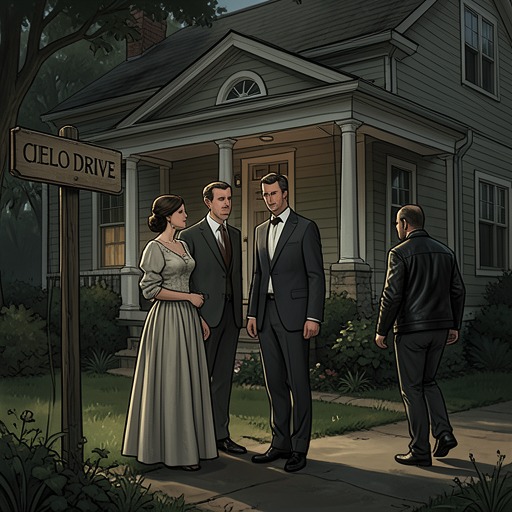
The first sight of Polanski and Sharon Tate comes through the sound and spectacle of their arrival: a vintage 1920s English roadster, Beatles music on the radio, and the couple waiting for their electronic gate to open. Polanski is driving; Sharon holds the gate clicker. Their conversation is animated, though Rick and Cliff cannot hear it over the engine and music. The scene gives the couple an effortless, glamorous public image, while the view from Rick’s side of the hill turns their ordinary arrival into a brush with celebrity.
Their marriage also appears in more domestic and less polished circumstances. After a night at Hugh Hefner’s Playboy Mansion, Polanski has committed himself and Sharon to another pair of engagements without first consulting her: an appearance on Playboy After Dark and a television appearance the following evening. Sharon is irritated. She would rather spend the evening in bed beside her husband reading Gore Vidal’s Myra Breckinridge than dress up again and perform her “sexy little me” public persona. Her displeasure makes the cost of celebrity concrete: the couple’s visibility requires time, preparation, and a performance that may not match what she wants privately.
A later drive home from Playboy After Dark continues the negotiation. At ten o’clock, after completing the television appearance, the couple race away from the Sunset 9000 building, passing Ben Frank’s Coffee Shop and the Tiffany Theater, where Andy Warhol’s Lonesome Cowboys is advertised. Polanski acknowledges that Sharon had not wanted to go out that night. She, in turn, points out that he can suddenly commit her to something she does not want to do. Their exchange does not erase the irritation; it makes their competing claims to consideration explicit. Elsewhere, Polanski jokes with Warren Beatty that life is too short not to drive a convertible, a light remark that places him among the fast-moving social world of Hollywood.
Hollywood Connections and the Novel’s Perspective
Polanski’s social world includes artists and celebrities who encounter one another through work and entertainment. Bruce Lee is known in Hollywood as a martial-arts instructor to wealthy and famous clients, and Polanski is among those who take classes with him at home, alongside Steve McQueen, James Coburn, Jay Sebring, and Stirling Silliphant. The detail situates Polanski within a network where professional and personal connections overlap, and where an instructor’s role can be folded into the everyday routines of celebrity life.
That network is not free of friction. Polanski and Steve McQueen dislike one another, but tolerate each other because McQueen is one of Sharon’s oldest friends in Los Angeles. At a meal with their American friends, Polanski is surprised by the juvenile pleasures they appear to enjoy—or pretend to enjoy. Sharon would prefer a hamburger without chili, but Jay Sebring refuses that option, and she gives in to the group’s pressure. The chili burger makes her feel ill on the ride back to Cielo Drive. The episode sets the group’s buoyant social performance against Sharon’s discomfort and Polanski’s bemusement, adding a small but precise counterpoint to the glamour of their public life.
The house on Cielo Drive also carries a history that predates the couple. They rent it from Rudi Altobelli, who lives in the guesthouse near the swimming pool. The former tenant Terry Melcher had shared the home with Mark Lindsay before Candice Bergen moved in with him. Sharon finds copies of The Spirit of ’67, an album associated with that earlier household, in the guest-room closet and plays it on the phonograph. Polanski reacts with a face that makes his dislike of the record plain. Their home is therefore both a private residence and a place already marked by other people’s lives and music.
Narrative Role
Polanski’s importance to the narrative rests on the meeting of reputation and physical proximity. To Rick, the director is a possible source of professional renewal: a celebrated neighbor whose next film might offer a role. To the reader, he is also part of the contrast between Hollywood’s public image and the negotiations behind it. The roadster, the gate, the television appearances, and the famous company establish the couple’s glamour; Sharon’s reluctance and Polanski’s belated acknowledgment of it show the personal arrangements that glamour can conceal.
His filmmaking is further defined through an account of his attention to composition on Rosemary’s Baby. When cinematographer Billy Fraker sets up a shot of Ruth Gordon as Mrs. Castevet making a telephone call in Rosemary’s bedroom, the camera is positioned in the hallway to look through the doorway. Polanski dislikes the framing as seen through the viewfinder and adjusts it. The episode presents directorial authorship as a practical decision about what the frame includes, rather than as celebrity alone. Together, the scenes make him both a director whose visual judgment shapes a film and a famous neighbor whose presence changes what Rick imagines possible.